Beautiful Gardens, landscaping, art, printing For Your Home And Garden!
Beautiful Gardens, landscaping, art, printing For Your Home And Garden!
Solar lights vs low voltage: compare brightness, reliability, installation, cost, and garden design to choose lighting that suits your outdoor room well.
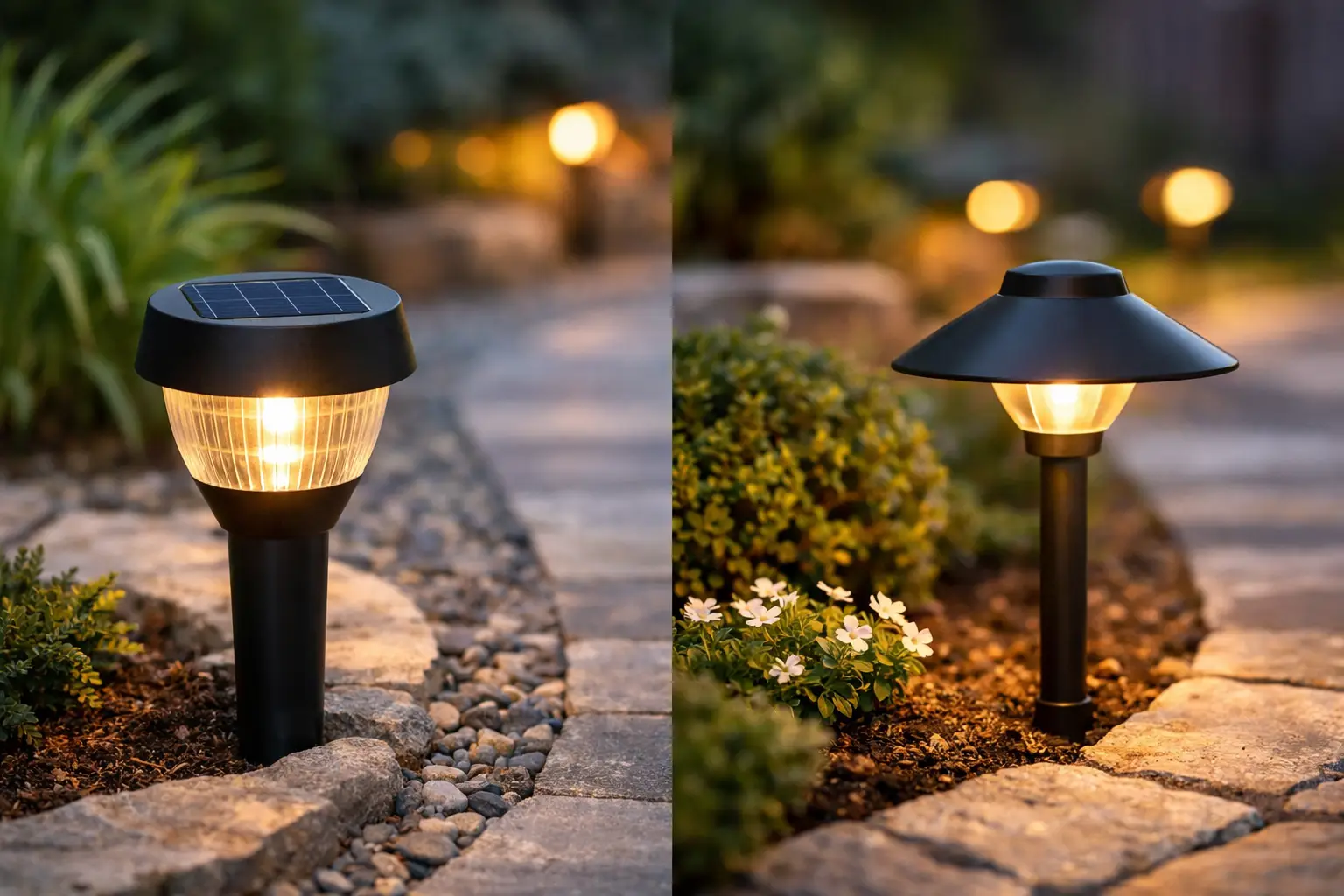
A garden changes character after sunset. The herb border becomes a soft silhouette, gravel takes on a moonlit texture, and the walk from patio to gate should feel inviting rather than uncertain. In the decision between solar lights vs low voltage, the best choice is not simply the one with the lowest upfront cost or the brightest beam. It is the system that lets your outdoor room stay useful, calm, and beautiful after dark.
For a relaxed, nature-led garden, lighting should feel more like a wash of lantern light across an ink painting than a row of spotlights demanding attention. Solar and low-voltage systems can both create that atmosphere. Their differences become clear in the places where real gardens live: beneath mature trees, along rainy pathways, beside dining tables, and through the shorter days of winter.
Solar lights make their own energy. A small photovoltaic panel collects sunlight during the day, stores it in a rechargeable battery, and powers an integrated LED after dusk. Most are self-contained, so there is no transformer, buried cable, or outdoor outlet required. Place them where they receive enough direct sun, and they are ready to work.
Low-voltage lighting uses electricity from your home, reduced through a transformer to a safer operating level, usually 12 volts. Fixtures connect to a cable that runs through planting beds, along paths, or beneath mulch. The system requires more planning, but it also delivers consistent power when the evening arrives.
That distinction shapes everything else. Solar lighting is wonderfully simple and flexible. Low-voltage lighting is more dependable and more precise. Neither is automatically better. A sunny courtyard with a few movable containers asks a different question than a shaded garden path used by family and guests every night.
Solar lights are at their best when you want to add atmosphere without turning a garden project into an electrical project. They suit balconies, rented homes, small patios, raised beds, and areas that are difficult to reach with cable. They also make sense for seasonal styling: a cluster around a summer table, a temporary glow beside a garden party, or a few stake lights defining the edge of a newly planted border.
Installation is their great pleasure. There is no trenching and little commitment. If a light feels too bright, too close to a chair, or visually out of place, you simply move it. That freedom works especially well in growing gardens, where perennials fill out, shrubs mature, and the shape of a path may evolve over time.
Solar also avoids using household electricity for routine decorative lighting. For households building a lower-maintenance, climate-aware landscape, that can be an appealing part of the picture. It is particularly useful in sunny, open spaces where the panel can receive six or more hours of direct daylight.
Still, solar lighting asks for realistic expectations. Its brightness and run time depend on the day that came before. A clear July day can charge a quality fixture well; a run of cloudy days may leave it dimmer and shorter-lived. Winter brings a double challenge: shorter daylight hours and a lower sun angle. Snow, fallen leaves, pollen, and dust can also reduce charging if panels are not cleaned occasionally.
Shade matters even more than many buyers expect. A border may look open at noon but be shaded for much of the day by a fence, roofline, or neighboring maple. Solar fixtures under dense tree canopies usually disappoint, no matter how handsome their design. They are best treated as accents, not as the sole source of safety lighting for steps, gates, or uneven paths.
Low-voltage lighting earns its place when the garden needs to function after sunset, not merely sparkle. It is the stronger choice for a front walk, stair treads, driveway edges, pool surrounds, and the route between the house and a detached studio or garage. It is also the better foundation for outdoor dining and lounge areas where people gather long after the sun has gone down.
Because the power supply is stable, low-voltage fixtures can produce more useful, predictable illumination. You can choose warm lamps that make stone, wood, foliage, and weathered metal feel rich rather than harsh. Timers, photocells, and smart controls can make the system nearly invisible in daily life: lights turn on at dusk, follow a schedule, or stay off when the space is not in use.
The design possibilities are also broader. A low path light can reveal the gentle curve of a walkway. A shielded downlight mounted in a tree can cast a quiet pattern on the ground. A carefully aimed uplight can give an olive tree, multi-stem serviceberry, or sculptural planter a presence without making it look theatrical. The goal is not to light every leaf. It is to create depth, orientation, and a sense of welcome.
Low voltage does require a greater initial investment. You need a properly sized transformer, cable, connectors, fixtures, and a considered layout. Although many systems are suitable for capable homeowners to install, complex projects or anything near water may benefit from professional guidance and local-code awareness. Cable runs should be planned before new beds, gravel, or hardscape are finished.
There is also maintenance, though it is usually manageable. Fixtures may need repositioning as plants grow, lenses may need cleaning, and connectors deserve a periodic check. Quality materials matter here. Thin plastic stakes and poorly sealed connections can turn a thoughtful lighting plan into a recurring repair task.
The most common lighting mistake is assuming more lumens create a better garden. In practice, too much light flattens planting, interrupts the view from indoors, and makes the night sky disappear. It can also disturb nocturnal insects and other wildlife that belong to a healthy garden ecosystem.
Start with purpose. A path needs enough light to see changes in level, but it does not need runway brightness. Steps and thresholds need clear illumination. A dining table benefits from warm, human-scale light. A specimen tree or textured wall may deserve a gentle accent. Everything else can remain softly ambiguous.
For either system, look for warm color temperatures around 2200K to 3000K. Warmer light tends to sit more naturally beside timber, brick, planting, and firelight. Choose fixtures with shields or downward-facing shades so the light lands where it is useful rather than spilling into a neighbor’s window or up into the sky.
This is where a layered approach often feels most natural. Use low voltage for permanent routes and key living zones, then let solar provide small, flexible gestures in the sunny corners. A few solar lanterns near pots of lavender or a bench can change with the season, while low-voltage path lights quietly keep the garden navigable every evening.
Solar usually costs less to begin with because the installation is so simple. But inexpensive solar fixtures may have limited battery life, weaker panels, and plastic components that weather quickly. When a sealed battery or LED fails, the entire unit may need replacing. Better solar fixtures cost more, yet still depend on the available sunlight.
Low-voltage systems cost more at the start, especially across a large property. Their long-term value comes from repairability and consistency. Individual fixtures, bulbs in compatible systems, connectors, and transformers can often be replaced without rebuilding the whole design. A well-planned system can also adapt as a garden matures, with additional fixtures added to a cable run when capacity allows.
Think beyond the price of one box of lights. Consider how often the space is used, how dark the site becomes in winter, and whether lighting supports safety, hosting, or simply a view from the kitchen window. A low-cost fixture that fails during the season you need it most is not always the economical choice.
Solar is usually the right answer if your garden is sunny, your lighting needs are decorative, and you value the ability to move or refresh the layout easily. It is a lovely companion for container gardens, informal borders, and spaces where no cable can reach.
Low voltage is usually the right answer if you need dependable visibility, have substantial shade, entertain outdoors regularly, or want a lighting plan that feels integrated with architecture and landscape. It is the quieter infrastructure behind a garden that truly works as an outdoor room.
For many homes, the most satisfying answer is both. Let permanent, low-voltage light guide the way and protect the practical moments. Let solar lights add a seasonal, almost accidental glow among planted textures and gathering spaces. When the light respects darkness as much as it reveals beauty, the garden feels alive well beyond sunset.