Beautiful Gardens, landscaping, art, printing For Your Home And Garden!
Beautiful Gardens, landscaping, art, printing For Your Home And Garden!
This drought resistant garden case study shows how layered planting, shade, and quiet water-saving systems create a beautiful, low-maintenance patio space.
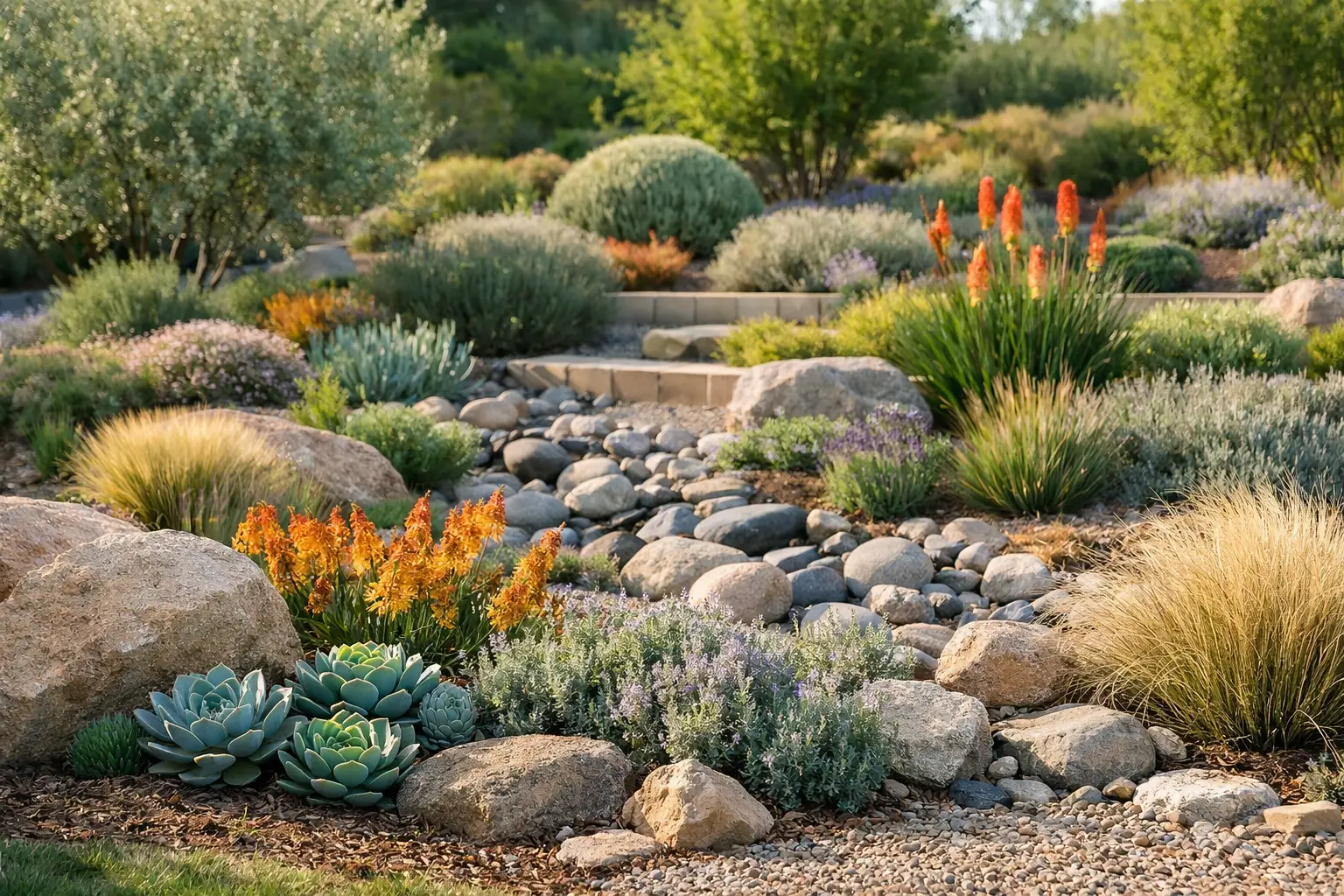
A hot west-facing patio can make even an attentive gardener feel defeated. Lawn thins at the edges, pots dry out before dinner, and every sunny weekend becomes a round of watering. This drought resistant garden case study looks at a more generous alternative: a small outdoor room designed to hold beauty, habitat, and family life with less water and less effort.
The project is a representative renovation scenario for a suburban American home: a 520-square-foot backyard bordered by a wood fence, with intense afternoon sun and compacted soil left after construction. The homeowners wanted a place for slow breakfasts, summer meals, and children’s muddy hands after school. They also wanted birds, pollinators, fragrance, and a garden that would not collapse when watering restrictions arrived.
Rather than treating drought tolerance as a sparse collection of gravel and cactus, the design treated water as part of the composition. Shade, soil, planting density, containers, and irrigation were arranged as one living system.
The original yard had a narrow concrete pad, a thirsty rectangle of turf, and two ornamental shrubs pressed against the fence. It looked neat from the kitchen window but offered little reason to step outside. Rainwater ran quickly over the hard surfaces, while the exposed lawn needed frequent irrigation to stay green through July and August.
The goal was not a zero-water garden. In most climates, new plants need consistent water while their roots establish, and containers always require more attention than plants in the ground. The goal was a garden that could become deeply rooted, seasonally responsive, and attractive without daily intervention.
The homeowners also had a visual request: they disliked rigid desert-themed landscapes. They wanted softness. The answer was a layered planting scheme inspired by the quiet depth of an ink landscape, where pale foliage catches light, darker masses recede, and empty space gives each form room to breathe.
Before any plants were chosen, the existing concrete pad was expanded into a simple dining terrace. A permeable gravel joint around its edge created a place for rain to enter the soil instead of rushing toward the drain. A slim pergola on the west side filtered the most punishing late-day sun, making the patio more comfortable while reducing evaporation from nearby planting beds.
This was a critical decision. Shade is often more useful than another hose. A lightly shaded sitting area can feel cooler by several degrees, and the plants at its perimeter experience less stress during heat waves. The pergola was kept visually open, so the garden retained bright morning light and a sense of sky.
The lawn was removed except for a small, flexible patch near the back door. This was a deliberate trade-off. A lawn can still earn its place when children use it, pets need it, or a household values an open surface for play. Here, a smaller lawn reduced water demand while preserving that everyday usefulness.
Along the fence, the design added a curved bed roughly four feet deep. The curve softened the rectangular plot and made room for plants with different root habits. Taller, drought-tolerant shrubs formed the backdrop; flowering perennials and grasses created the middle layer; aromatic ground covers knitted the edge together. The result was not a perfectly clipped border. It was a garden that looked alive, even between blooms.
Compacted soil was loosened with broadforking rather than repeatedly turned over. Two inches of finished compost were worked into the planting zone, followed by a two- to three-inch layer of shredded bark mulch. The mulch was kept a few inches away from stems and crowns to avoid rot.
This combination changed the practical behavior of the space. Compost helped the soil hold moisture while supporting soil life. Mulch reduced surface evaporation, buffered root temperatures, and limited weeds that would compete for water. It also made the bed look finished, allowing the planting to feel intentional from its first season rather than waiting years for every gap to fill.
In regions with heavy clay, the lesson is not to create a small pocket of rich soil around each plant. That can encourage roots to circle within the amended hole. Improve the broader bed gradually and choose plants that can adapt to the site. In very sandy soil, organic matter and mulch become even more valuable because water drains away quickly.
The planting scheme relied on plants selected for more than drought tolerance alone. Each needed to contribute texture, flowers, scent, seed, shelter, or seasonal structure. Native species were prioritized where they suited the local region, then paired with well-adapted Mediterranean and prairie-style plants.
At the back of the border, serviceberry and redbud provided light shade, spring blossom, and food for birds. In a hotter, drier climate, desert willow or a locally appropriate native shrub could take that role. The important principle is scale: a small tree or large shrub can protect a whole community of lower plants without overwhelming a compact garden.
The middle layer mixed coneflower, yarrow, salvia, beebalm varieties bred for mildew resistance, and little bluestem. These plants brought different rhythms to the same bed. Yarrow held its flattened flower heads through dry spells. Salvia offered repeated color when deadheaded. Little bluestem moved in the wind and turned coppery in fall, long after many flowers had finished.
Near the patio, creeping thyme, sedum, and low-growing oregano spilled toward the paving. Their fragrance made the garden participatory: a hand brushing the edge of the bed released scent, and herbs could be gathered for a salad or a pitcher of iced tea. Not every edible plant thrives under low irrigation, so thirsty crops such as lettuce and basil were kept in a small, easy-to-water container garden close to the kitchen.
That distinction matters. A resilient garden is not one in which every plant receives identical treatment. It groups plants by water needs. The thirstiest herbs and annual flowers stay near a faucet or drip line; established shrubs and dryland perennials occupy the outer beds. This simple zoning prevents the entire garden from being watered for the sake of one demanding plant.
The irrigation system used drip tubing beneath mulch, divided into two zones: one for new in-ground planting and one for containers. A simple timer watered early in the morning, when less moisture is lost to heat and wind. For the first growing season, the deep-rooted shrubs and perennials were watered slowly and thoroughly, then allowed to dry slightly between sessions.
After establishment, the schedule was reduced rather than maintained out of habit. Deep, occasional watering encourages roots to travel downward; frequent shallow watering keeps them near the surface, where heat reaches them first. The exact schedule depended on local rainfall, soil texture, plant age, and temperature. A gardener should check soil moisture several inches below the surface instead of watering because the mulch looks dry.
Rain barrels were included for hand-watering pots and newly planted areas after summer showers. They were not presented as a complete irrigation solution. In a long dry spell, a barrel empties quickly. But capturing roof runoff made the homeowners more aware of rainfall as a resource and covered much of the container garden’s supplemental water needs during milder weeks.
The most visible change was not a single flower or piece of furniture. It was use. The patio became a genuine outdoor room because the pergola made late afternoons bearable and the planting offered privacy without a solid green wall. Birds began visiting the serviceberry, and bees worked through the salvia and coneflower from early summer into fall.
The garden also became easier to maintain, but not maintenance-free. Mulch needed replenishing, young plants needed observation, and some perennials were cut back in late winter rather than autumn to leave seed heads and shelter for wildlife. A few plants failed where reflected heat from the patio proved stronger than expected. They were replaced with tougher species rather than given more water forever.
That is the useful lesson in this drought resistant garden case study: resilience is not a fixed plant list. It is a design process that notices what the site is saying. A hot wall may call for shade-loving containers moved elsewhere. A low pocket may hold rain longer and suit a different plant community. Gardens become more beautiful when they are allowed to respond.
Fensgarden approaches this kind of space as a composition of shelter, texture, and daily ritual. A weathered planter, a shaded chair, and a planting bed alive with movement can carry as much meaning as a large landscape. Begin with the place that feels hardest to keep alive, then give it better soil, gentler shade, and plants that know how to endure. That difficult corner may become the one that draws everyone outside.