Beautiful Gardens, landscaping, art, printing For Your Home And Garden!
Beautiful Gardens, landscaping, art, printing For Your Home And Garden!
Outdoor lighting for garden ambiance shapes mood, depth, and comfort. Learn how to layer light for a garden that feels warm and beautifully lived.
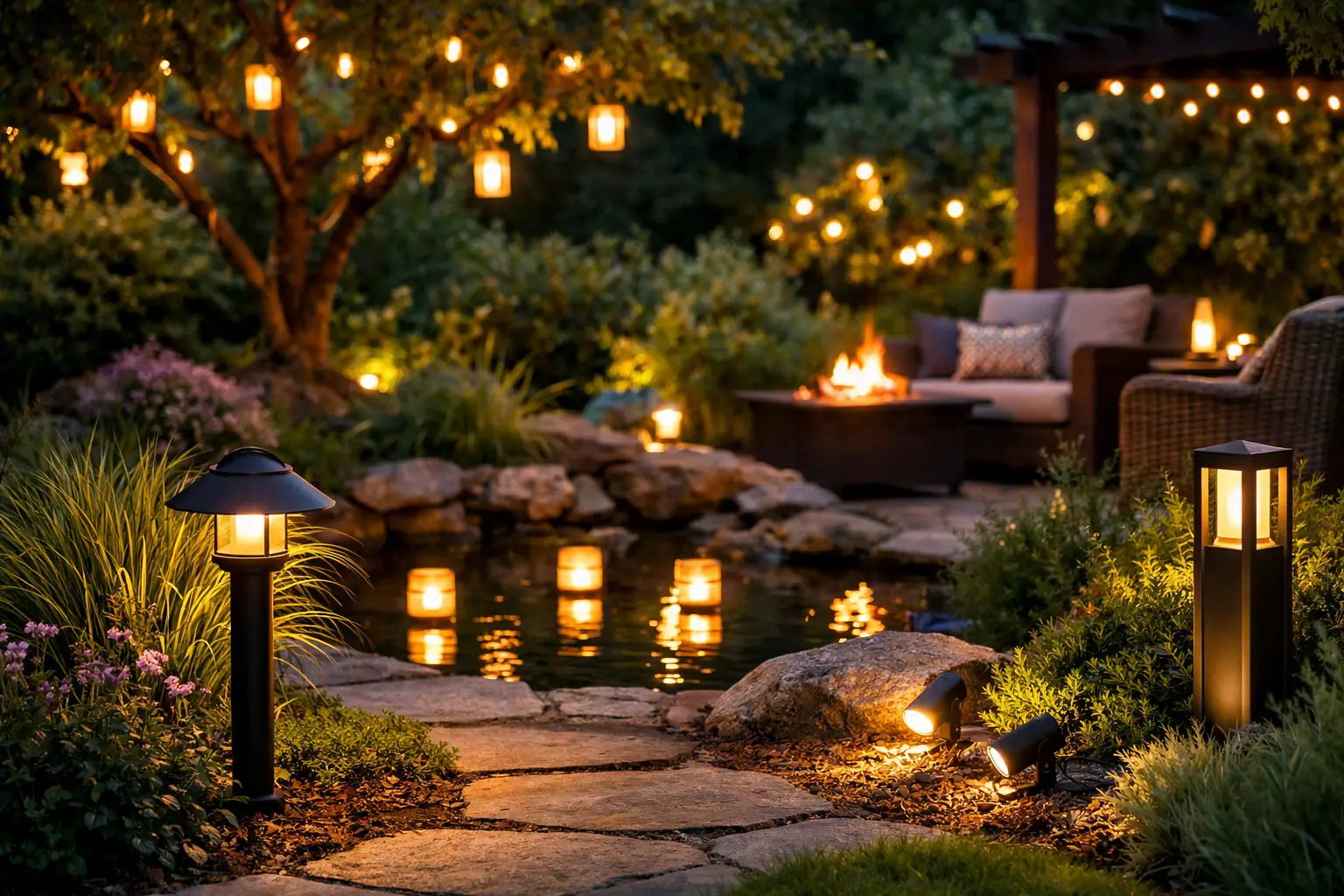
A garden rarely feels complete when the sun goes down. The planting may be thoughtful, the seating may be inviting, and the textures may be beautiful in daylight, but without the right glow, the space can flatten into darkness. Outdoor lighting for garden ambiance is what gives a landscape its evening character – quiet, intimate, and expressive rather than simply visible.
The difference comes down to intention. Good garden lighting is not about making everything bright. It is about deciding what should recede, what should shimmer, and where people should naturally want to linger. In a well-lit garden, a gravel path feels calmer, leaves take on depth, and even a small patio begins to feel like a destination.
Ambiance is mood shaped by light. In the garden, that usually means softer contrast, layered brightness, and a rhythm that feels natural instead of theatrical. A harsh floodlight may help with visibility, but it often erases the very atmosphere people want from an outdoor space.
The most beautiful gardens after dark usually combine three things: gentle wayfinding, selective highlights, and a warm sense of enclosure. You might guide the eye along a path, bring attention to the branching form of a Japanese maple, or wash a fence with a low glow so the yard feels finished at the edges. None of that requires a large property. It requires restraint.
This is where many outdoor setups go wrong. Homeowners often install lights one by one over time, choosing whatever solves the immediate need. A porch light here, solar stake lights there, maybe string lights overhead. Each piece may work on its own, but together they can feel scattered. Ambiance starts to happen when the lighting is treated as part of the garden composition, not an afterthought.
Before choosing bulbs or finishes, decide how you want the garden to feel at night. Some spaces are meant for dinner with friends and need a welcoming, social glow. Others are more reflective – a bench near planting, a quiet side yard, a courtyard viewed from indoors. The same property can even hold more than one mood.
A good rule is to think in scenes. What do you see first from inside the house? Where do guests walk? Which corner deserves a pause? If your garden has a sculptural tree, a raised bed with dramatic foliage, or a pergola that frames the sky, those elements can anchor the nighttime design.
This mood-first approach matters because brightness alone does not create beauty. A softly lit olive tree against a darker backdrop will often feel richer than an entire yard illuminated at the same level. Contrast creates atmosphere. Shadow does too.
Path lights are often the first thing people buy, and they are useful, but they are easy to overdo. If every few feet is marked by a bright point of light, the result can look more like a runway than a garden. Better path lighting gives enough visibility for safe movement while keeping the source discreet.
Lower output fixtures with warm color temperature usually work best. Staggering lights from side to side can feel more natural than rigid spacing. On a short path, you may need fewer fixtures than you think, especially if nearby walls, gravel, or planting can catch and reflect a little glow.
Accent lighting is where personality enters. This is the layer that reveals bark, leaf form, stone texture, water, or artful planting. Uplighting a tree can create a dramatic canopy, but subtle downlighting from a pergola or branch can feel more moonlit and calm.
There is no single right technique. A clipped hedge may benefit from an even wash, while ornamental grasses often look best when lit from behind or below so they appear airy. It depends on what the material does in light. Smooth leaves reflect differently than matte stone. A white planter may glow softly with very little illumination, while dark fencing may require more careful placement.
This final layer is the least technical and often the most important. Ambient light is what makes a seating area feel inhabited rather than merely visible. It can come from lantern-style fixtures, concealed LEDs under a bench, soft wall lights, or a few well-placed string lights if the setting is casual.
The trade-off is balance. Too little ambient light and people cannot comfortably gather. Too much and the garden loses mystery. For dining areas, a warm, diffused glow tends to flatter both people and materials. For lounge spaces, lower light is often enough.
For most residential gardens, warm white light creates the most inviting atmosphere. It complements wood, stone, terracotta, and greenery, and it feels more in tune with dusk and candlelight. Cooler light can make a landscape feel sharper or more contemporary, but it also risks looking sterile in a planted setting.
That said, style matters. A minimalist courtyard with architectural concrete and black metal may tolerate a slightly cooler tone better than a cottage garden or a lush planting scheme. The key is consistency. Mixing several color temperatures in one small yard can make the lighting feel accidental.
Brightness matters just as much as warmth. Many gardens are overlit because fixtures are chosen for output rather than effect. In practice, lower levels of light often feel more luxurious. When the eye adjusts, a subtle garden can feel richer than a bright one.
Low-voltage wired lighting tends to give the most reliable and polished result. It offers better control, more fixture options, and consistent output over time. If you are designing a full garden or renovating hardscape, it is often worth planning for it early.
Solar lighting has improved and can be useful for small gardens, renters, or quick upgrades, especially in sunny climates. Still, performance varies with season, panel placement, and product quality. If ambiance is your priority, cheap solar lights often disappoint because they flicker inconsistently or cast light that feels cold and thin.
Battery and rechargeable fixtures can work well for flexibility, especially with decorative lanterns or tabletop lighting. They are less ideal when you want a permanent, layered system. A beautiful garden at night usually benefits from something more deliberate.
One of the simplest ways to improve outdoor lighting for garden ambiance is to hide the source whenever possible. People respond more strongly to the effect of light than to the fixture itself. A concealed glow under foliage or behind a planter often feels more refined than a visible spotlight.
Think about vertical surfaces. Light aimed only at the ground can leave the garden feeling empty beyond the path. Fences, walls, tree trunks, and tall planters help define the edges of space. When those surfaces catch a gentle wash of light, the garden feels deeper and more complete.
Also consider the view from indoors. A garden is part of the home even when no one is outside. A single illuminated tree, a softly lit water bowl, or a warm pool of light at the end of a path can turn a window into a framed evening scene. For a design-led brand like Fensgarden, this relationship between indoor comfort and outdoor atmosphere matters. The best gardens are not separate from the home. They extend it.
Lighting fixtures do not need to be decorative to be beautiful. In many gardens, the best choice is a quiet one – matte finishes, simple silhouettes, and forms that disappear into planting or architecture. This is especially true if your outdoor space already includes expressive materials, patterned textiles, or artful planters.
If your aesthetic leans toward Eastern-inspired calm, choose fixtures and placement that support negative space and rhythm. Let one lantern mark an entry. Let one tree carry the visual weight. Resist outlining every border. Atmosphere grows stronger when not every feature asks for attention.
That does not mean minimalism is the only answer. A lively patio with layered textiles and outdoor entertaining may welcome pendants, string lighting, or decorative sconces. The important thing is coherence. The lighting should feel like part of the garden language.
A thoughtful garden at night should feel easy to enter and hard to leave. If the light is warm, selective, and a little restrained, the space begins to hold its own kind of stillness – one that invites conversation, rest, and a longer look at the leaves moving in the dark.