Beautiful Gardens, landscaping, art, printing For Your Home And Garden!
Beautiful Gardens, landscaping, art, printing For Your Home And Garden!
Compare cantilever umbrella vs market umbrella for shade, layout, wind, upkeep, and style, then choose the right form for your outdoor room at home today.
A patio umbrella does more than interrupt harsh afternoon sun. It sets the ceiling line of an outdoor room, frames a dining table, and decides whether a planted terrace feels open and airy or crowded with poles and hardware. In the cantilever umbrella vs market umbrella decision, the better choice is rarely about which silhouette looks more luxurious. It is about how your family actually moves, eats, rests, and watches the garden change through the day.
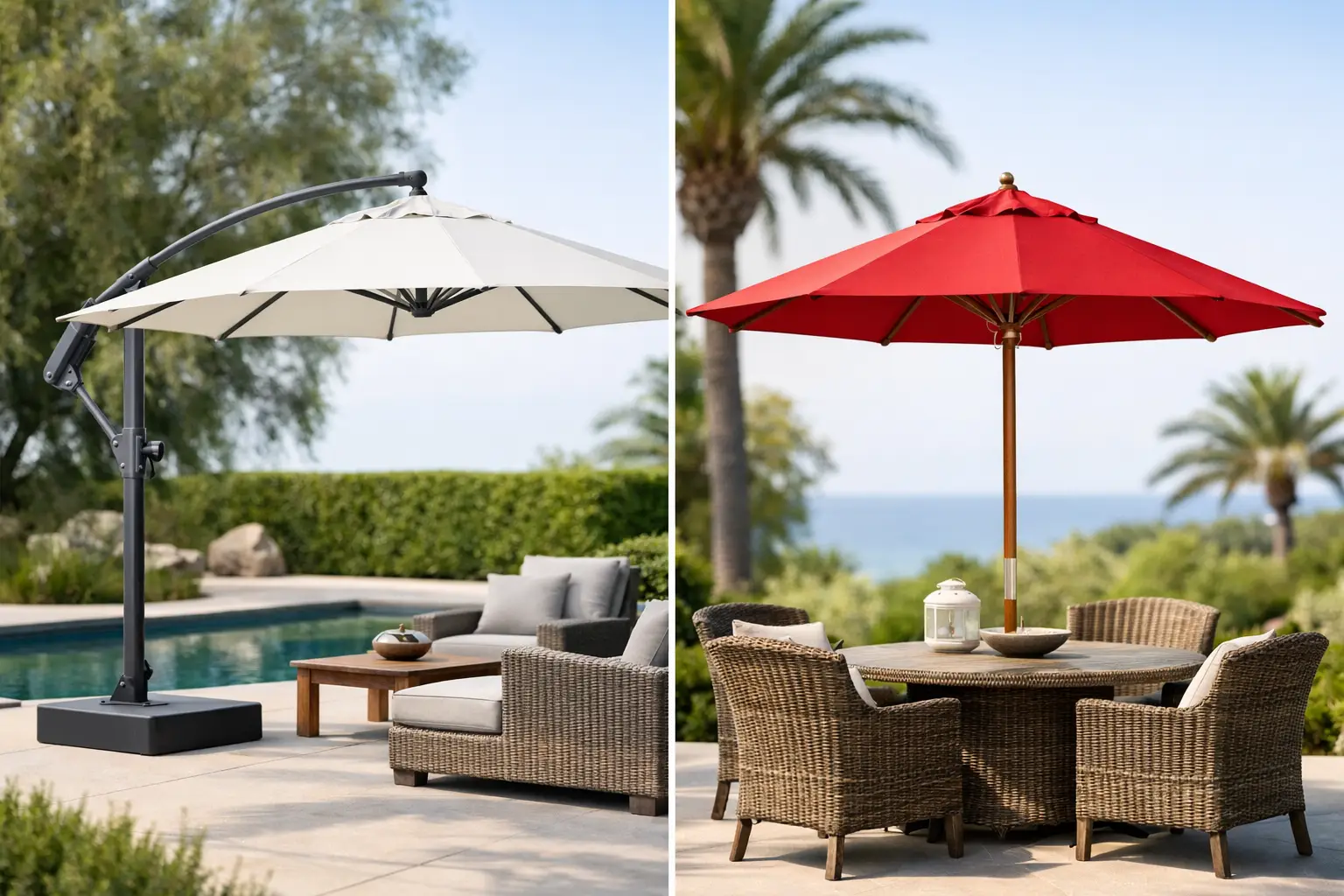
A market umbrella is the familiar centered-pole design, usually placed through a table or in a freestanding base. A cantilever umbrella, also called an offset umbrella, carries its canopy from a side-mounted arm. Both can create beautiful shade. Their differences become clear when you consider layout, wind exposure, maintenance, and the kind of life you want your garden to hold.
The pole is the defining feature. With a market umbrella, the support rises through the center of the canopy. That straightforward structure makes it visually calm, easy to understand, and well suited to a bistro table, café-style seating, or a compact balcony dining set. It gives the scene a pleasing sense of order – like a small pavilion gathered around one central point.
A cantilever umbrella places the pole outside the shaded area. The canopy reaches over a lounge set, a long dining table, or a pair of chaise lounges without asking anyone to work around a center pole. This creates an uninterrupted patch of shade and a more architectural profile. It can feel especially right for an outdoor room where the furniture is arranged as generously as it would be indoors.
Neither form is automatically superior. A market umbrella makes a modest dining nook feel settled and intimate. A cantilever model gives a larger, flexible terrace room to breathe. Start with the activity beneath the canopy, not the umbrella alone.
If your table has a dedicated umbrella hole and seats four to six people, a market umbrella is often the most sensible answer. The pole becomes part of the table’s geometry, while the canopy shades everyone evenly. This is an efficient choice for a breakfast terrace, a gravel patio beside an herb bed, or a small deck where every inch matters.
For a rectangular table without a center hole, or a long table used for summer suppers, a cantilever umbrella can be more comfortable. No one has to negotiate with a pole while serving platters or arranging flowers. The side support also lets you shift the canopy toward the late-day sun without moving the dining furniture.
Cantilever umbrellas are usually stronger for lounge zones. Their open underside suits low sofas, daybeds, reading chairs, and the loosely arranged furniture of a relaxed outdoor living room. A well-proportioned offset canopy can shade the people rather than the empty space between them.
That said, a market umbrella can bring charm to a smaller sitting area. Place one beside two chairs and a side table, perhaps near fragrant planting or a water bowl for birds, and it reads less like a large structure and more like a garden accent. Its scale can feel gentler among flowering borders and young trees.
A cantilever umbrella is useful when shade needs to fall beside an object rather than through it. Think of a pool edge, an outdoor kitchen counter, or a children’s activity table. Many offset designs rotate or tilt, allowing the canopy to follow the sun as it moves across the yard.
Flexibility has a practical limit. A rotating canopy adds moving parts, weight, and wind sensitivity. If you want simple, dependable shade in one place, a market umbrella with a quality tilt mechanism may be the wiser long-term choice.
Umbrellas are large visual objects. Treat them as part of the landscape composition, much like a pergola, specimen tree, or tall planter. The goal is not to cover every square foot of paving. Leave sunlight for herbs, pollinator-friendly flowers, and the shifting patterns that make a garden feel alive.
A market umbrella generally works best when its canopy is proportionate to the table below it. A round canopy softens square patios and circular tables. A square or rectangular version can echo the lines of a deck, dining table, or planter wall. Because the pole is centered, the design feels naturally symmetrical.
A cantilever umbrella has more visual presence because its base and arm occupy one side of the scene. Choose it when there is room for that gesture. On a narrow balcony, the offset base can consume valuable floor area and make circulation awkward. On a broad patio, however, the same form can create a graceful horizontal line, almost like a tree branch extending over a clearing.
Canopy color matters, too. Soft sand, warm stone, muted green, and ink-like charcoal tend to sit quietly among foliage and natural materials. Bright white can look crisp but may show pollen and dust quickly. Very dark canopies create dramatic shade, yet they can feel heavy in a small enclosed yard. Consider the colors already present in your paving, furniture, and planting rather than treating the umbrella as an isolated purchase.
The most beautiful canopy is not useful if it is constantly closed, rattling, or at risk in a gust. Before choosing either style, observe your site. Wind often funnels between houses, accelerates around a corner, or sweeps across an exposed deck more strongly than expected.
Market umbrellas tend to have a simpler load path: the canopy sits directly over its pole. With the correct base and a table that stabilizes the shaft, they can be a reassuring option for moderately breezy dining areas. Simplicity also means fewer joints to inspect over time.
Cantilever umbrellas need a substantial base because the canopy’s weight extends away from the support. A base that looks adequate but is underweighted can become a serious hazard. Large offset umbrellas are best reserved for protected patios or locations where they can be closed promptly when conditions change. Never rely on a tilt setting, a furniture tie, or wishful thinking during high winds.
Whichever style you choose, close the canopy when you are not using it and before storms. A fitted cover reduces sun fading, dust, and moisture exposure. Check the frame, crank, ribs, and locking points at the beginning of each warm season. This small ritual protects both the umbrella and the people gathering beneath it.
The base is not an accessory. It is part of the umbrella system. A market umbrella needs a base sized for its canopy, pole diameter, and local wind conditions. A table provides additional steadiness, but it does not replace the need for proper ballast.
Cantilever umbrellas typically use large weighted bases, often with separate fillable sections or heavy slabs. They can be difficult to move once installed. Plan their position before filling the base, and leave a clear path for doors, grills, and garden maintenance. If your patio arrangement changes frequently, a market umbrella is often easier to reposition.
Also consider what happens when the umbrella is closed. A market umbrella folds into a neat vertical form, usually close to its table. A cantilever canopy may need more clearance beside a wall, fence, or planting bed. Measure the open and closed footprint, not only the advertised canopy diameter.
For the canopy, look for fabric made for outdoor ultraviolet exposure and fading resistance. Solution-dyed acrylic is often valued for color retention and a soft textile feel, while polyester options can be more budget-friendly. What matters most is appropriate care: let the canopy dry before covering it, brush off debris, and clean spills gently rather than storing stains for the season.
Frames are commonly aluminum, steel, or wood. Powder-coated aluminum is light, low-maintenance, and well suited to contemporary patios. Wood brings warmth and a more traditional garden character, though it asks for periodic care. Steel can be sturdy but should have reliable protective finishing, particularly in humid or coastal conditions.
For a landscape that values natural texture over perfect uniformity, an umbrella should age with dignity rather than compete with the planting. Pair refined hardware with weathered timber, stone, textured ceramics, and layered greens. The contrast between a clean canopy line and a slightly untamed border can make the whole space feel more lived in.
Choose a market umbrella if your priority is table-centered dining, a smaller footprint, straightforward setup, or a classic garden rhythm. Choose a cantilever umbrella if your priority is clear space beneath the canopy, adaptable shade over lounge furniture, or an outdoor room arranged beyond the limits of a dining table.
If you are still undecided, mark the proposed canopy area on the ground with painter’s tape or lay out a sheet in a similar size. Sit in the chairs at the time of day you most use the patio. Notice where the sun reaches your shoulders, where the path to the garden narrows, and which view you do not want to block. The right umbrella will not merely cast shade. It will make it easier to linger among the plants, meals, conversations, and quiet moments that give a garden its life.