Beautiful Gardens, landscaping, art, printing For Your Home And Garden!
Beautiful Gardens, landscaping, art, printing For Your Home And Garden!
Choose the right patio umbrella size for dining, lounging, and garden living with practical clearance rules, shape tips, and design-led guidance at home.
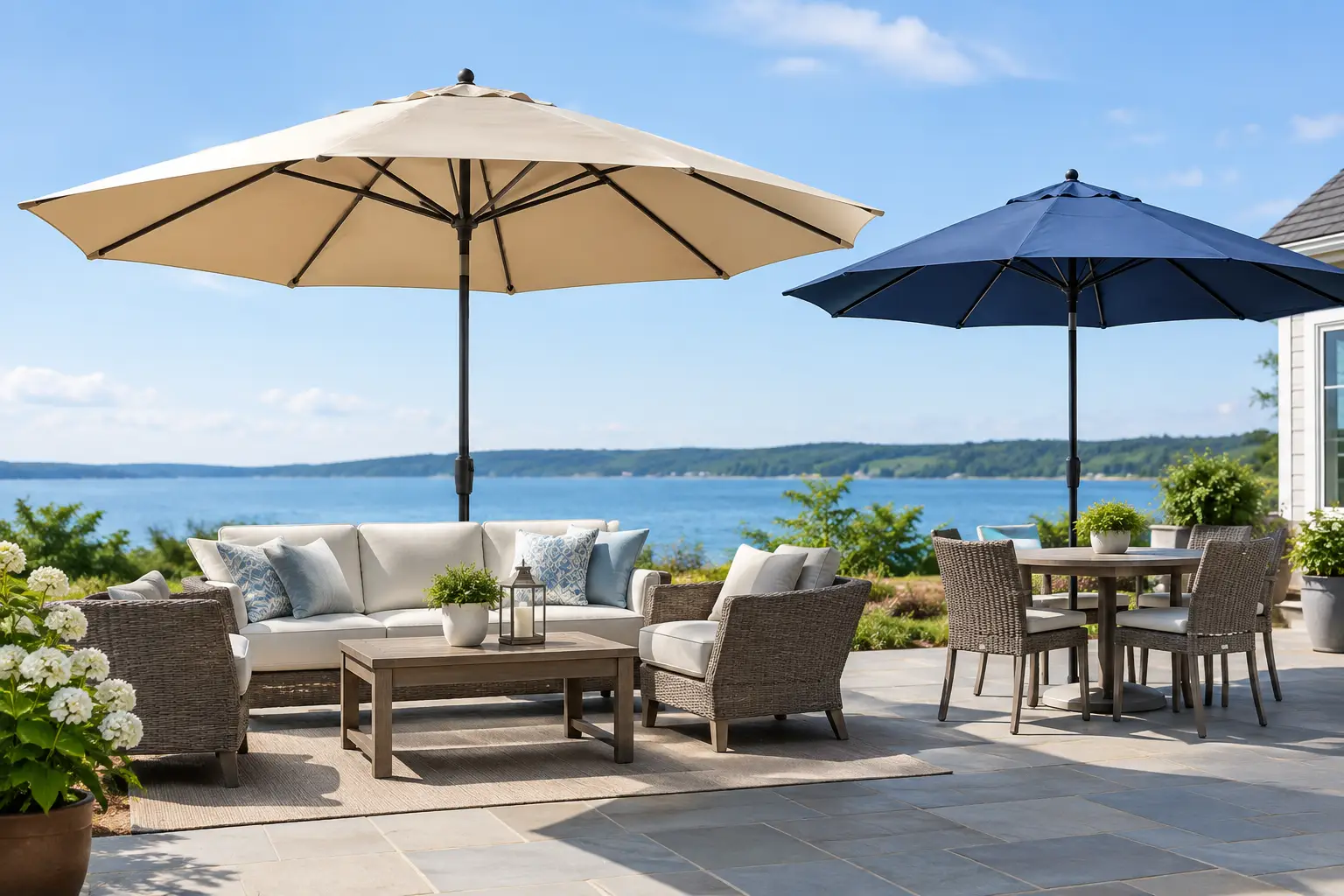
A patio umbrella should do more than cast a dark circle over a table. It should make the terrace feel inhabitable at noon, soften the glare on a reading chair, and create a calm threshold between the house and a living garden. Choosing the right patio umbrella size is what turns a useful outdoor accessory into part of the landscape.
The answer is not simply “bigger is better.” An oversized canopy can overwhelm a narrow deck, block a favorite view, or catch too much wind. One that is too small leaves diners shifting chairs with the sun. The most successful choice considers the furniture below it, the changing path of light, circulation around the space, and the visual scale of your planting and architecture.
Measure the entire area where people sit, not only the tabletop. A table may be 48 inches wide, but the occupied footprint becomes much larger once chairs are pulled out and guests are moving around it. As a reliable starting point, choose a canopy that extends at least 2 feet beyond each side of the table or seating arrangement.
For example, a 48-inch round dining table generally feels best beneath a 9-foot umbrella. That extra coverage protects the people at the perimeter, where shade is most often lost as the sun angles lower. A 6- or 7.5-foot umbrella may cover the center of the table, but it rarely provides enough room for four chairs over a long lunch.
Think of shade as a moving composition rather than a fixed shape. In early afternoon, the canopy may cover the table perfectly. By late afternoon, sunlight arrives from the side, and the useful shaded area shifts. If your patio is used most often for evening meals, a tilting umbrella or a slightly larger canopy can be more valuable than a small umbrella that only works at midday.
Furniture provides the clearest starting point, but each setting has its own proportion and practical needs.
For a bistro table measuring 24 to 36 inches across, a 6- to 7.5-foot umbrella is usually enough. This scale suits compact balconies, apartment terraces, and intimate garden corners where a large canopy would feel heavy. Keep at least 12 to 18 inches between the canopy edge and walls, railings, or tall planters so the space can still breathe.
A smaller umbrella can also be intentional in a layered garden. Paired with fragrant herbs, climbing jasmine, or a sculptural planter, it creates a focused place for morning coffee without trying to cover the entire terrace.
A 9-foot umbrella is the classic choice for round tables up to 54 inches wide and square tables around 48 inches wide. It is substantial enough for everyday family dining while remaining easy to integrate into most patios.
For a rectangular table, shape matters as much as span. A rectangular umbrella often gives cleaner, more efficient coverage than a round one because its edges follow the lines of the furniture. A 6-by-9-foot or 6-by-11-foot canopy works well for a table seating six, depending on its length and whether the chairs have wide arms.
An 11-foot umbrella can shade a 60-inch round table or a larger square dining set. For long dining tables, look for rectangular canopies around 8 by 12 feet, or consider two smaller umbrellas. Two canopies give you more flexibility, especially when part of the table is used for serving, cooking, or children’s activities.
This is also where a cantilever umbrella can be useful. With the pole positioned to one side, the whole dining surface remains open. It is especially effective beside an outdoor kitchen island, where a center pole would interrupt the layout.
A lounge area is often wider and less regular than a dining set, so measure its full footprint from the outer edge of one chair to the outer edge of the next. A 10- or 11-foot round umbrella can work beautifully over two chaise lounges or a small conversation set. For a deep sectional, a 10-by-13-foot rectangular cantilever model may be more appropriate.
Poolside shade deserves extra thought. You may want sunlight on the water while keeping a single retreat cool and protected. Instead of covering the entire pool deck, position the umbrella over the place where people actually pause: the loungers, the towel bench, or the small table for cold drinks.
Round umbrellas have a soft, generous presence. They complement circular tables, curved paths, and gardens with looser planting schemes. Their silhouette can echo the fullness of ornamental grasses, hydrangeas, or small multi-stem trees.
Square umbrellas bring a more architectural rhythm and are especially effective over square tables or symmetrical seating layouts. They can also sit neatly beside a wall, low hedge, or pergola post without wasting much canopy coverage.
Rectangular umbrellas are often the smartest answer for narrow patios, long dining tables, and outdoor kitchens. Their geometry creates shade where it is needed rather than spreading it into paths or planting beds. In a compact urban yard, that efficiency can make a larger seating area feel possible.
The canopy’s shape should not compete with the garden. If the planting has a relaxed, meadow-like character, a round canopy may feel more natural. If the patio is defined by clean stone joints, linear benches, and a water feature, a square or rectangular form may create a more considered balance.
A well-sized umbrella makes outdoor life easier, not more awkward. Before buying, mark the canopy dimensions on the ground with painter’s tape or a garden hose. Then pull out chairs, open nearby doors, and walk the routes people use to carry food, water plants, or move between the house and yard.
Aim for at least 30 inches of clear passage around the main seating zone whenever space allows. On smaller terraces, the canopy can extend over a planting bed or lawn, but avoid placing it so close to a house wall, tree branch, or fence that it cannot open fully.
Look upward, too. A canopy needs clearance from eaves, string lights, branches, and pergola beams. Standard market umbrellas are commonly 8 to 9 feet tall when open, while cantilever designs can require more room because of their curved or offset support arms.
Do not underestimate the importance of preserving sightlines. An umbrella positioned directly between the dining area and a flowering border, a distant tree, or a view beyond the garden can make the whole space feel closed. Sometimes shifting the pole 18 inches changes everything.
Patio umbrella size and base weight are inseparable. A broad canopy behaves like a sail, especially on exposed decks, upper-floor balconies, and coastal properties. A base that seems adequate in still weather can become unstable with one strong gust.
Always follow the manufacturer’s guidance, but as a general reference, a 9-foot center-pole umbrella commonly needs a base around 50 pounds or more when used through a table. An 11-foot model may need 75 pounds or more. Cantilever umbrellas typically require significantly heavier bases, often using fillable or sectional weights designed for that exact frame.
A table is not a substitute for a proper base. Its umbrella hole helps stabilize the pole, but it does not anchor the canopy against wind. Close the umbrella whenever it is unattended or when wind picks up, even if the sky is clear.
The largest umbrella is not always the coolest. Canopy fabric, ventilation, and color influence comfort. A vented canopy allows warm air to escape and can reduce wind pressure, while quality outdoor fabric helps resist fading and offers more dependable sun protection.
Light colors brighten a small patio and can feel airy beside pale stone, gravel, or silvery foliage. Deeper mineral tones such as moss, clay, charcoal, and ink blue give a more grounded, garden-room feeling. They also frame the sky and surrounding greenery with greater visual depth.
At Fensgarden, we see the umbrella as part of a larger outdoor composition: a quiet plane of shade set among texture, water, planting, and handmade detail. Choose a color that belongs to the materials already present, whether that is weathered wood, limestone, black metal, or the softened greens of a resilient native planting scheme.
For a large patio, one giant canopy can be visually dominant and difficult to manage. Two 9-foot umbrellas often create a more intimate result than one 13-foot model, while allowing each area to be adjusted independently. This approach works particularly well when a dining table and lounge area sit side by side.
Multiple umbrellas can also create a changing pattern of shade across the day. One may cover breakfast on the east side of the patio, while another becomes useful later near a west-facing lounge. The result feels less like a roof and more like a garden made for lingering.
The best umbrella is the one that makes you stay outside a little longer. Measure generously, leave room for movement, and let the canopy support the life of the garden rather than conceal it.