Beautiful Gardens, landscaping, art, printing For Your Home And Garden!
Beautiful Gardens, landscaping, art, printing For Your Home And Garden!
Plan solar outdoor lighting for a garden that feels warm, safe, and alive after dark, with better placement, softer light, and less upkeep year-round.
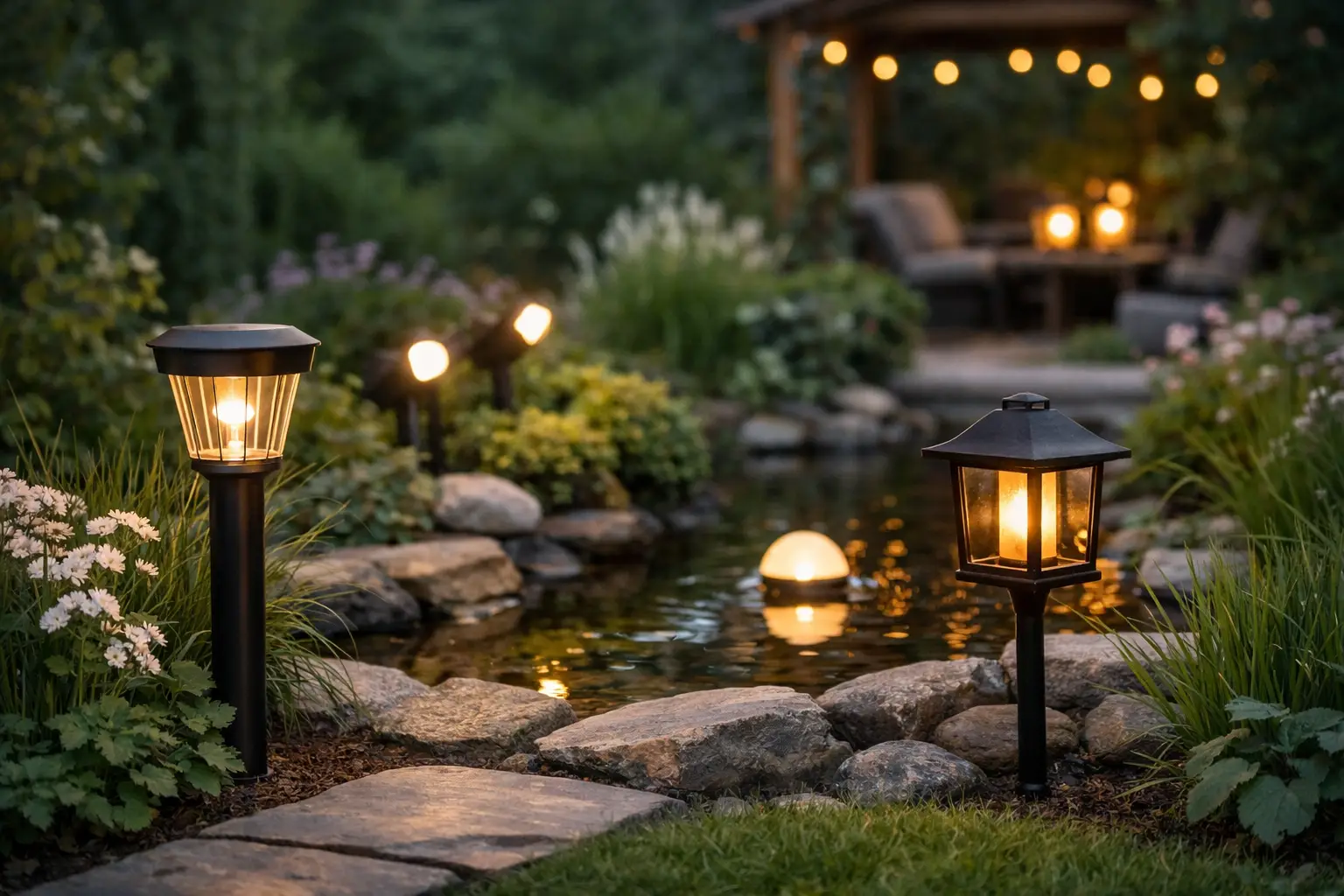
A garden changes character the moment daylight leaves it. The silhouette of a serviceberry, the edge of a gravel path, steam lifting from an evening cup of tea – these details do not need floodlights to be felt. Thoughtful solar outdoor lighting gives an outdoor room a second, quieter life after sunset, without adding wires across a patio or asking for another switch to remember.
For a garden designed to feel natural rather than overly controlled, light should behave like moonlight passing through leaves: useful where feet need guidance, gentle where plants and people need rest. That balance is what separates a welcoming landscape from a yard that feels permanently on display.
Before choosing fixtures, walk outside at dusk and notice where the garden asks for light. A front walk may need clear orientation for arriving guests. A dining terrace benefits from warm, low-level illumination that lets people see one another without washing out the night sky. A bench beneath a tree may need almost none, except for a soft pool of light nearby that makes it feel inviting.
Think in scenes rather than products. The route from the back door to the patio is one scene. A raised herb bed used for late-summer picking is another. The view from an indoor living room toward a planted border is a third. This approach prevents the common mistake of lining every path and bed with identical stakes. Repetition can feel orderly, but it rarely feels alive.
Solar fixtures work especially well where running low-voltage cable would disturb established planting, paving, or a rented outdoor space. They are also useful for gardens that will continue to evolve. A young native border may need a light moved as shrubs gain height, while a new seating area may shift once a family discovers where the evening breeze is best.
Solar lighting is simple, but it is not magic. Each fixture needs enough direct sun to charge its panel, and its performance changes with season, weather, latitude, and the quality of its battery. A light that glows beautifully for eight hours in July may offer only a few useful hours after a gray December day.
That does not make solar a poor choice. It means placement matters more than packaging claims. In much of the United States, a panel receiving six or more hours of direct sun has the best chance of reliable performance. A fixture tucked beneath dense evergreens, under a covered porch, or within a deeply shaded north-facing border is likely to disappoint, even if the lamp itself is in the ideal location.
Look for a separate solar panel when the desired light location is shady but a sunny patch is available nearby. The panel can often be positioned several feet away, letting you illuminate a woodland path, a pergola interior, or a sheltered entry without compromising charging. For essential security lighting at a gate, stairs, or a frequently used driveway, wired low-voltage or hardwired fixtures may still be the more dependable choice. Solar is strongest when it supports atmosphere, flexible wayfinding, and seasonal use rather than carrying every functional demand alone.
Color temperature has an outsized effect on a small landscape. For lounging, dining, and planted areas, choose warm white light around 2200K to 3000K. It resembles candlelight or a traditional filament bulb, so bark, stone, terracotta, and foliage retain their depth.
Cool white lighting can make blue-gray paving appear sharper, but it often turns a planted garden flat and clinical. It may also feel jarring when viewed from inside the home. If a product only describes its output as “bright white,” check whether it provides a Kelvin rating before committing to a full set.
Brightness should be modest, too. Path lights are for seeing the path, not for lighting the entire lawn. A few restrained points of warm illumination allow the eye to adapt and preserve the mystery of darker planting beyond. This is more restful for people and less disruptive for nocturnal wildlife.
A layered planting plan gives each height and texture a role. Outdoor lighting benefits from the same thinking. Begin at ground level with discreet markers near changes in level, step edges, and turns in a path. Space them according to the beam spread instead of placing them at rigid intervals. On a narrow walk, alternating sides can create a more relaxed rhythm and reduce the runway effect.
Next, add a small number of vertical accents. An upward-facing solar spotlight can reveal the branching structure of a multi-stem tree, the grain of a timber screen, or the broad leaves of a large planter. Aim the beam slightly across a surface rather than directly at it. Cross-lighting draws out texture, while a harsh, straight-on beam can create glare and hard shadows.
Finally, create a human layer at table height. Lanterns, portable lamps, or softly shaded solar fixtures near a dining or conversation area make an outdoor room feel occupied rather than merely decorated. Their value is emotional as much as practical: they invite someone to stay for one more course, one more story, or ten quiet minutes alone after the children are asleep.
Fensgarden approaches this kind of composition as a landscape painting: a few intentional points of light, balanced by shadow and planting, can suggest far more depth than a fully illuminated yard.
A living garden is not only a view for humans. Moths, pollinators, birds, and other creatures rely on darker periods and familiar rhythms. Avoid placing bright lights directly at the entrance to bird boxes, within dense nesting shrubs, or beside nighttime-blooming flowers that attract pollinators.
Use shields or downward-facing fixtures whenever possible. They keep light on the surface that needs it and reduce spill into neighboring yards and the sky. Motion sensors can also be a considerate choice for side yards and service routes, where continuous lighting is unnecessary. For the main seating area, a low setting or a timer creates a calmer result than an always-on glare.
If you grow edible plants, reserve brighter task light for the path beside the kitchen garden rather than shining directly onto every bed. You will still be able to cut mint for a drink or harvest herbs for dinner, while leaves, soil, and beneficial insects get a quieter night.
The best-looking fixture is not a good value if water enters its housing after the first hard rain. Check for an outdoor weather-resistance rating, a sealed battery compartment, and materials suited to your local conditions. Powder-coated metal, quality stainless steel, UV-resistant resin, and thick glass generally age better than thin painted metal or brittle plastic.
Coastal gardens need particular care. Salt air can corrode metal quickly, so rinse fixtures occasionally and choose finishes designed for marine exposure where possible. In snowy climates, avoid placing stakes where snow shovels, plows, or frozen ground will damage them. Removable solar lights are often practical for exposed seasonal beds.
Battery replacement is another overlooked detail. Rechargeable batteries gradually lose capacity, often before the fixture itself wears out. Models that allow easy battery replacement can extend the useful life of a favorite light for years. Clean solar panels every few weeks during pollen season, after storms, and whenever leaves collect on them. A soft cloth and water are usually enough; abrasive cleaners can cloud the surface.
Start smaller than you think. Place lighting at the entry, along the safest route to the main outdoor room, and around one focal point such as a specimen tree, water bowl, or sculptural planter. Then live with it for several nights. View it from the kitchen window, from the street, and from the chair where you actually sit.
Notice where shadows feel beautiful and where they create uncertainty. A single additional light at a step may be more valuable than six more scattered through the border. Gardens are growing compositions, and the lighting should be allowed to change with them.
When the final effect is right, you may not notice every fixture at all. You will notice that the patio feels easier to enter, the planting has a soft after-dark presence, and the garden still belongs to the night.